Holding Joy and Sorrow Together on Mother’s Day
What happens when Mother’s Day holds both celebration and grief? This reflective piece explores miscarriage, motherhood, remembrance, and the hope of Christ amid joy and sorrow.
This post is a follow-up to Courtney’s Mother’s Day 2025 post about her miscarriage: Walking With Mary: A Mother’s Day Reflection on Loss and Faith
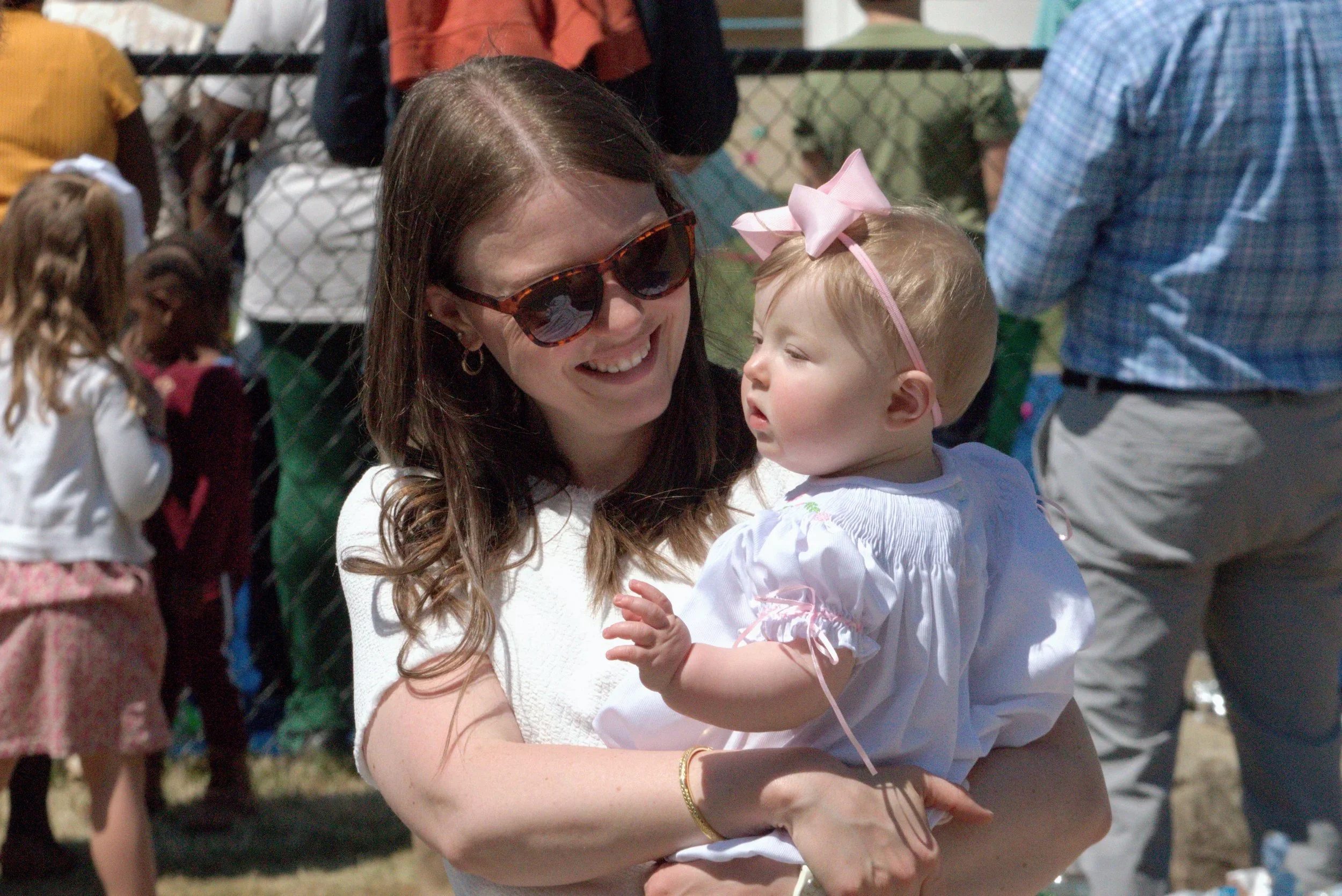
Courtney Merriman with her daughter.
“This is your first Mother’s Day, isn’t it? Are you going to do anything special?”
My friend's question was asked out of love and excitement for me in this new season of motherhood. But the answer in my mind was complicated. This would technically be my second Mother’s Day, but how do you explain that the first time I celebrated Mother’s Day, I was also grieving my unborn baby? I suffered a miscarriage in August 2025, after carrying my baby for 10 weeks.
This year, Mother’s Day looks a lot different. I now have a beautiful baby girl who is almost nine months old. She brings so much joy to my life, and I am so grateful to get to be her mom. But even in the joy, there are times when I think about her unborn sibling, and who that baby would have been.
If there is one thing I’m learning as motherhood unfolds, it is that being a mom is filled with immense joy, and also much sorrow. The two emotions often live hand in hand. And while I can at times feel tempted to push the sorrow aside, I believe that there is purpose in it.
Our hurts can draw us to deeper joy with Christ, and our joys remind us to practice remembrance and reflection on God's faithfulness. Mother’s Day can be the perfect time to do just that.
Something that has come to my mind several times during this new season of motherhood is a liturgy from the book Every Moment Holy. The title is “A Liturgy for Embracing Both Joy and Sorrow.” It’s easy to embrace joy, but not so easy to embrace sorrow. We all feel it, but embrace it? I think we’d rather not, especially if sorrow is related to our children. I would much rather look at my daughter and feel the joy of her presence now, instead of being reminded of the loss I had previously experienced.
But this liturgy calls grief a necessary experience, one that is needed for joy to be true. “For joy that denies sorrow is neither hard-won, nor true, nor eternal. It is not real joy at all.”
In our sorrow, we have the choice to turn into ourselves, or to turn to Christ, the Man of Sorrows. The liturgist writes:
“Let me neither ignore my pain, pretending all is okay when it isn’t, nor coddle and magnify my pain, so that I dull my capacity to experience all that remains good in this life.”
Sorrow must not be ignored, but it also must not be magnified. Only Christ is worthy to be magnified in our lives. And He invites us to cry out to Him. “Do not be distant, O Lord, lest I find this burden of loss too heavy,” the liturgy continues. We see that plea echoed in the Psalms:
“Hear my prayer, O Lord; let my cry come to you. Do not hide your face from me in the day of my distress. Incline your ear to me; answer me speedily in the day when I call.” Psalm 102:2
Jesus invites us to cry out to Him and call Him to come close to us. His love for us is unending. As parents, our capacity for love expands with every child we welcome into our family. Knowing this, can we imagine the type of love Jesus has for us, His children? Because of His love, He does not cause our sorrow, but He does allow it. And He uses it to make us more into his own image. It is in our seasons of grief that we can experience the joy of knowing Jesus deeper.
As mothers, allowing ourselves to feel joy can seem risky, especially as mothers who have experienced a loss. Throughout my pregnancy with my daughter, I often felt fear and anxiety, afraid that what happened with my first pregnancy would happen again.
The moments of joy–feeling her kick, or hiccup, or getting an ultrasound–were often fleeting. I would be excited, but that excitement would quickly turn into uneasiness and anxiety.
What if I don’t feel her move again? What if this ultrasound brings bad news?
It was easy for me to say I trusted the goodness of God, but harder for me to always believe it. I find the words of the liturgy to be what I hope and pray:
“So give me strength, O God, to feel this grief deeply, never to hide my heart from it. And give me also hope enough to remain open to surprising encounters with joy, as one on a woodland path might stumble suddenly into dapplings of golden light. Amidst the pain that lades these days, give me courage, O Lord; courage to live them fully, to love and to allow myself to be loved, to remember, grieve, and honor what was, to live with thanksgiving in what is, and to invest in the hope of what will be.”
We must feel and honor our grief, but God does not want us to remain in it. He wants us to find joy in what He has planned for us, in the love of others, in the surprises He has in store. This takes courage because, with love, there is always the great risk of loss.
But Jesus bids us to take heart, to invest in the hope to come. We can have hope of joy in this life, but we know that there is a greater hope coming, when Christ will come to make all things new and right. While we wait for this, we can honor our grief with the practices of remembrance and thanksgiving.
In the Bible, one way we see the Jewish people practicing remembrance is with the celebration of Passover. The festival was a celebration of God’s deliverance of the Israelites out of Egyptian captivity. Still, it can be assumed that in this celebration there could have been some sorrow over the history of God’s people.
But God commanded them to remember His faithfulness to them, and every year they did this with the Paschal feast. It was on this occasion that Jesus instituted the sacrament of Communion, the greatest act we, as Christians, can partake in to remember Christ’s sacrifice for us.
Each time we take Christ's body and blood in Communion, we are reminded of how Jesus became the Passover lamb for us, giving His own body and blood as the perfect sin offering.
Communion is a beautiful means of grace in which Christ is truly present with us as we remember and give thanks for his sacrifice. We grieve over his unjust death and our sins, but we find hope in His resurrection. The great hymn from Isaac Watts paints a beautiful image of this sacrifice with the words:
“See, from His head, His hands, His feet, sorrow and love flow mingled down. Did e'er such love and sorrow meet, or thorns compose so rich a crown?”
Sorrow and love mingled together, one not existing without the other, in the greatest sacrificial act.
Much like motherhood, in the sacrifice of so many things—our freedom, our past identity, our careers, even our bodies—sorrow and love flow mingled down. But we know that what waits for us is not a crown of thorns, but one of gold, that we will cast with joy at the throne of our Savior. And so, in the meantime, in the moments of joy and sorrow that life brings, we continue to pray the remaining words of the liturgy:
“Be at work gilding these long heartbreaks with the advent of new joys, good friendships, true fellowships, unexpected delights. Remind me again and again of your goodness, your presence, your promises.
For this is who we are: a people of The Promise—a people shaped in the image of the God whose very being generates all joy in the universe, yet who also weeps and grieves its brokenness.
So we, your children, are also at liberty to lament our losses, even as we simultaneously rejoice in the hope of their coming restoration.
Let me learn now, O Lord, to do this as naturally as the inhale and exhale of a single breath:
To breathe out sorrow, to breathe in joy.
To breathe out lament, to breathe in hope.
To breathe out pain, to breathe in comfort.
To breathe out sorrow, to breathe in joy.
In one hand I grasp the burden of my grief, while with the other I reach for the hope of grief’s redemption.
And here, between the tension of the two, between what was and what will be, in the very is of now, let my heart be surprised by, shaped by, warmed by, remade by, the same joy that forever wells within and radiates from your heart, O God.
Amen.”
TL;DR
Motherhood often holds joy and sorrow at the same time.
Grief should neither be ignored nor allowed to consume us.
Christ meets us in both lament and hope as the “Man of Sorrows.”
Communion, remembrance, and gratitude help anchor us in God’s faithfulness.