What if heaven isn't just our future destination, but the key to how we live today? On All Saints Sunday, William Merriman explores Revelation 21 and how the hope of eternity transforms our desires, restores our brokenness, and calls us to become who we already are in Christ. Discover what it means to live as a pilgrim, find hope in suffering, and bring heaven to earth through a life of holiness and love.
-
“Then I saw a new heaven and a new earth, for the first heaven and the first earth had passed away, and the sea was no more. And I saw the holy city, new Jerusalem, coming down out of heaven from God, prepared as a bride adorned for her husband. And I heard a loud voice from the throne saying, ‘Behold, the dwelling place of God is with man. He will dwell with them, and they will be his people, and God himself will be with them as their God. He will wipe away every tear from their eyes, and death shall be no more, neither shall there be mourning, nor crying, nor pain anymore, for the former things have passed away.’ And he who was seated on the throne said, ‘Behold, I am making all things new.’”
Made for Another World: How the Hope of Heaven Changes How We Live Now
This is one of my favorite passages in all of Scripture. It is a glimpse of our ultimate destiny. And on All Saints Sunday, when the church remembers those who have gone before us into the presence of God, it is a fitting place to ask a simple question: how should the hope of heaven shape the way we live right now?
I believe it does at least three things. It teaches us to live as pilgrims. It gives us hope in the middle of suffering. And it calls us to become saints.
Living as Pilgrims on the Way Home
The great stories of the Western tradition share a common theme: the quest, and very often, the long journey home. Think of The Odyssey, The Divine Comedy, the legends of King Arthur and the Holy Grail, The Lord of the Rings, and of course that modern masterpiece, The SpongeBob SquarePants Movie.
Those stories resonate with us because they describe our real situation. We are wayfarers on a journey toward our true home. Revelation 21 gives us a look at that home, the country you have been longing for all your life, whether you realize it or not.
C. S. Lewis once wrote that while there have been times when he thought he did not desire heaven, more often he wondered whether “in our heart of hearts, we have ever desired anything else.”
What did he mean? This longing for heaven is like a faint melody we were born remembering. It is a secret thread running through all our hopes and joys, always just beyond our reach. Beautiful things awaken it: a mountain landscape, a piece of music, a waterfall, a good story, a sky full of stars. But nothing in this world ever fully satisfies it. When we finally arrive home through faith in Christ, we will cry out like Jewel the Unicorn at the end of the Chronicles of Narnia, “I have come home at last! This is my real country!”
If that is true, then this world and its comforts are not our home. The joys we experience here are signposts pointing ahead to the real thing. Friends, do not mistake the signpost for the destination. A trail marker on a hike may be a fine place to stop for a drink of water, but it is not the place to set up camp. Keep climbing. The view is waiting at the top.
Peter writes, “Beloved, I urge you as sojourners and exiles to abstain from the passions of the flesh, which wage war against your soul” (1 Peter 2:11). The word can also be translated as “pilgrims.” Christian tradition has a phrase for this: homo viator, the human being on the way. We are pilgrims bound for heaven, but we are easily tempted to settle down here.
Next Vine, Tarzan
Author and teacher Christopher West once described a conversation with his spiritual director about his struggle with lust and his temptation to look for ultimate fulfillment there. His director looked him in the eye and offered some of the most profound spiritual counsel I have ever heard: “Next vine, Tarzan.”
He was referring to an old 1980s video game called Jungle King, in which you swing from vine to vine, trying to get as far as you can. If you stop swinging, you slip, you fall, and the game is over. His director had no idea it was West’s favorite childhood game.
The point was simple. Ultimate fulfillment is not found in this world. It is found only in God, who is the true fulfillment of every longing we have. That silly phrase has become something of a spiritual motto for me whenever I feel tempted to make an earthly thing ultimate. Next vine, Tarzan.
As one writer famously put it, the man knocking on the door of a brothel is really looking for God. Heaven is what we are all actually after. This world and the desires of the flesh will promise to be our home, but they can never keep that promise. Lorenzo Albacete observed that every temptation ultimately comes down to one: the temptation to believe that satisfying the deepest desires of my heart is entirely up to me. Believe that, and you will miss the infinite joy you were made for.
Setting Your Mind on Things Above
Living as pilgrims means doing what Paul urges: “Set your minds on things that are above, not on things that are on earth” (Colossians 3:2).
So where has your mind been set? What have you been daydreaming about, treasuring, making your home in? Money? Possessions? Relationships? Your appearance? SEC football? Your fantasy team? (Guilty.) Mahjong? None of these things is wrong in itself. Many of them are good gifts. But as John Calvin warned, our hearts are idol factories. We are quick to take good things and turn them into ultimate things.
Here is the great secret: when you believe in heaven, you do not get less of earth. You get more. Heaven is not the opposite of earth; it is earth made perfect. Revelation shows us creation renewed and restored, a world where God dwells with humanity and His will is done completely. Lewis put it memorably: aim at heaven, and you get earth thrown in; aim at earth and you get neither.
Some people assume that believing in heaven makes you a “pie in the sky” escapist who cares little for this world. They have it exactly backward. History shows that the most heavenly-minded people, the saints, have done the most earthly good. William Wilberforce and the abolitionists who ended the British slave trade, Mother Teresa, Dietrich Bonhoeffer, John Wesley: they left their mark on this world precisely because their minds were fixed on the next. Heavenly-minded people love the good things of earth for what they truly are, gifts to be received and stewarded, rather than mistaking them for sources of ultimate contentment.
Your Desires Reveal Your Design
Our longings tell us something about who we are. A baby gets hungry because food exists. A duck wants to swim because water exists. You are a finite creature carrying infinite desires that this world awakens but can never satisfy. As Lewis concluded, the most probable explanation is that we were made for another world. You were made for heaven, to be filled by an infinite God.
The vision of Revelation stirs our thirst for the only thing that can truly satisfy it: “To the thirsty I will give from the spring of the water of life without payment” (Revelation 21:6). Jesus said the same to the Samaritan woman who had been drinking from the world’s wells: “Everyone who drinks of this water will be thirsty again, but whoever drinks of the water that I will give him will never be thirsty again” (John 4:13–14). The writer Fr. Thomas Dubay described the human person as an “incarnate thirst.”
So what are you thirsting for? What have you been trying to fill yourself with? Through Jeremiah, God grieved that His people had forsaken Him, “the fountain of living waters,” and dug for themselves “broken cisterns that can hold no water” (Jeremiah 2:13). Your soul is a well made for God. Fill it with anything else, and you will stay empty. Fill it with Christ, and His living water will overflow into abundant, eternal life.
A heavenly-minded person lives an unusually good life. It is a life that relishes beauty and goodness, rich in contentment rather than chasing one quick high after another. It can endure failure and loss because Christ is its victory. It fights injustice, because it prays, “Your will be done, on earth as it is in heaven” (Matthew 6:10). It is a life of presence in a distracted world and peace in an anxious one, rooted in what is eternal rather than what is passing away. And it is a life of sacrificial love, because Love Himself died for us.
Not Too Strong, but Too Weak
The verses that follow our passage draw a sharp line. Those who conquer will inherit these things and be called God’s children, “but as for the cowardly, the faithless, the detestable, as for murderers, the sexually immoral, sorcerers, idolaters, and all liars, their portion will be in the lake that burns with fire and sulfur” (Revelation 21:7–8). These are people who made earth their home and refused a greater joy.
Lewis suggested that our Lord finds our desires not too strong but too weak. We settle for far less than the infinite joy we are offered. In his words, “We are far too easily pleased.”
But hear this clearly: heaven is not for people who have never struggled with sin. Paul gives a similar list in 1 Corinthians 6, then adds, “And such were some of you. But you were washed, you were sanctified, you were justified in the name of the Lord Jesus Christ and by the Spirit of our God” (1 Corinthians 6:11). Heaven is for forgiven sinners, washed by the blood of Jesus and made new by His grace.
Did you notice how those who are condemned in Revelation are named? By their sins. Sin had become their identity, and they would not let it go. But in Christ, we are not defined by our sins. “For our sake he made him to be sin who knew no sin, so that in him we might become the righteousness of God” (2 Corinthians 5:21). Your identity is not the worst thing you have ever done. It is what Jesus has done for you. In Christ, your name is Beloved.
Jesus promises, “To the one who conquers I will give... a white stone, with a new name written on the stone that no one knows except the one who receives it” (Revelation 2:17). No longer a liar, no longer an idolater, no longer defined by your past. Beloved. Accepted. Cherished. Son. Daughter.
What Do You Really Want?
So what does your heart most desire? In the end, we all get what we truly want. But happiness cannot be found where it does not exist, and it does not exist apart from God, the source of all goodness and joy.
The most dangerous word in the spiritual life might be the one the seagulls squawk in Finding Nemo: “Mine! Mine! Mine!” Lewis wrote that in the end there are only two kinds of people: those who say to God, “Thy will be done,” and those to whom God says, “Thy will be done.” Those who choose themselves over God are finally given what they chose.
Is there sin you are holding on to? The Lord can and will set you free, but you have to want it. And if you do not want it yet, pray for the desire: “Lord, help me want You. Not my will, but Yours be done” (Luke 22:42). He is faithful to give every grace, even the grace to warm your heart toward Him.
Augustine famously prayed, “Lord, make me chaste, but not yet.” He wanted his sin to change before grace changed his heart. In his Confessions, he describes crying out, How long will I keep saying ' tomorrow '?” Why not now? Why not end my sin this very hour? Maybe that is where you are today. Cry out to God. He will deliver you, be your victory, and give you a new name.
Hope in Suffering: The Beauty of Kintsugi
The hope of heaven also gives us hope in the middle of suffering.
Several years ago, at the close of a student retreat, we celebrated Communion with an earthenware chalice. After the service, one of our students accidentally dropped it, and it shattered across the floor. He was devastated. In a small moment of grace, I told him, “Take heart. Jesus’ blood spilled on Calvary was redemptive. This can be redemptive, too.”
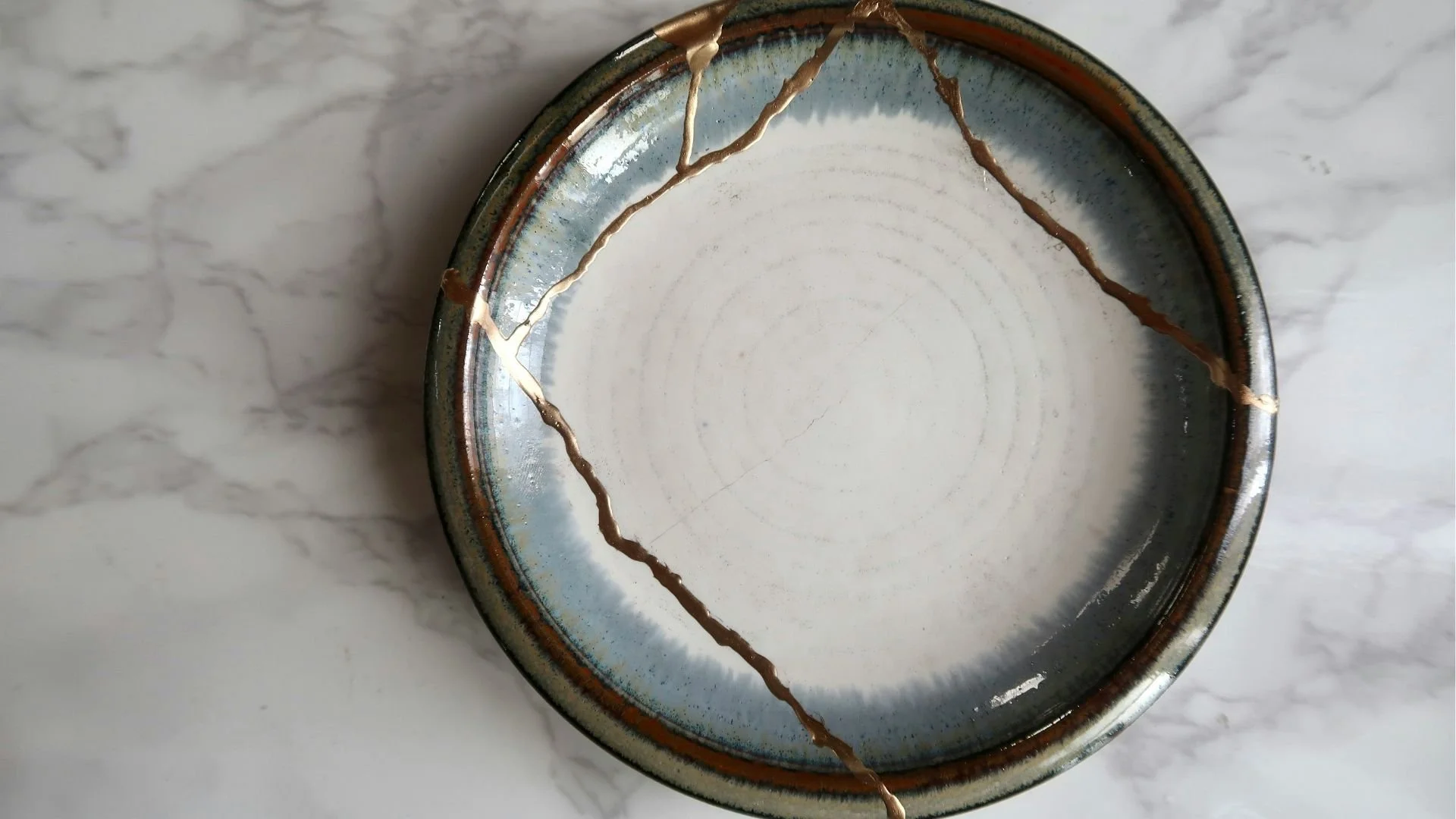
I gathered up the broken pieces and felt God nudging me that He had a purpose for them. So I kept them in my office and began dreaming of restoring the cup through kintsugi. Kintsugi is the Japanese art of mending broken pottery with gold. The finished piece is threaded with rich golden veins that make it more beautiful and more precious than it was before. The cracks that once marred it become its most treasured feature.
Not long ago, before a charity bike ride that raises money for cancer care, one of the ride’s founders asked if I knew where to find an earthenware chalice. He wanted to present it as a gift to honor one of the ride leaders, a man whose wife was going through cancer treatment. I searched and came up empty, and then I remembered the broken cup sitting in my office. I sensed God saying, Now is the time.
I ordered a kintsugi repair kit overnight. It was not real gold, more like glorified super glue with glitter, but my wife and I pieced that cup back together with golden seams. On the last night of the ride, I gave the restored cup to my friend as a sign of gratitude and as a symbol of the season he was walking through, a season of hurting and hoping.
I believe that cup pictures all our lives. Whether through our own sin, sin done against us, or simply the brokenness of this world, we all end up shattered. We wonder how we could ever be whole again after what has happened or what we have done. If that is where you are, hear the good news: if the resurrection is real and heaven is real, then every wound will be healed.
Wounds Transformed by Glory
Your brokenness does not push God away. It is the very thing that qualifies you to be put back together by Him. “The Lord is near to the brokenhearted” (Psalm 34:18), and He loves to restore broken things, broken people, and broken lives. He took the greatest suffering in history, the cross, where the body of Jesus was broken, and made it the means of our redemption. The resurrection proves that nothing is impossible for our God.
That restoration begins the moment we believe: “If anyone is in Christ, he is a new creation. The old has passed away; behold, the new has come” (2 Corinthians 5:17). We are God’s workmanship, His masterpiece, created anew in Christ Jesus (Ephesians 2:10). Yet the work may not be finished until we see Jesus face to face. Some wounds may not fully heal until heaven.
But somehow, like kintsugi, we will be more beautiful for having been broken. Not in spite of our wounds, but because they have been transformed by the resurrection of Christ.
It is a wonder to me that even in His resurrected body, Jesus still bears His wounds, the marks in His hands, His feet, and His side. Yet those scars are no longer reasons to weep in grief, but to weep for joy. With earthly eyes, you could see only nails. In the light of heaven, you look through those wounds and see glory. Trust that your own wounds, seen through heaven’s eyes, will become something Jesus uses for good, no longer a source of shame but traced with gold and transfigured by a tender Father.
You do not choose your wounds. But you do choose what to do with them. It has been said that pain that is not transformed is transmitted. You can pass your pain on to others, or you can give your wounds to our wounded and risen Savior, who joins them to His own and makes even your suffering meaningful. The same Lord who held out His scarred hands to Thomas (John 20:27) holds them out to you.
When we are hurting, we are tempted to believe that this pain is the final reality. But Scripture tells us that heaven is more real, more lasting, and more true than the evil of this world. In the light of that reality, as J. R. R. Tolkien imagined it, everything sad will come untrue. “I consider that the sufferings of this present time are not worth comparing with the glory that is to be revealed to us” (Romans 8:18). When you are broken, meditate on heaven. Let its light pierce your heart and piece it back together, giving you hope, patience, and courage to press on.
Becoming Saints: Clothed in Christ
Finally, the reality of heaven calls us to become saints.
When I was a little boy, I saw the first Spider-Man movie and walked out of the theater convinced I was Spider-Man. I acted like him, played like him, and dreamed like him. One day after karate practice, I decided that Spider-Man would never simply ride an escalator, so I started climbing up the outside of one. For a moment I felt pure joy and power. Then my “spidey sense” kicked in; I realized I was not Spider-Man, I panicked, and I fell and broke my arm.
Pretending gave me the courage to try something I never would have attempted otherwise. But it could not change the fact that I was’t Spider-Man.
Researchers have studied something called the “Batman effect.” In one well-known study, young children were given a long, tedious task. Children who were encouraged to imagine themselves as a hero like Batman, especially while wearing a costume, persevered far longer than the others. Simply stepping into a different identity changed how they acted.
Now consider this: “I have been crucified with Christ. It is no longer I who live, but Christ who lives in me” (Galatians 2:20). If you have put your faith in Jesus, you have been clothed with Christ (Galatians 3:27). You have the mind of Christ (1 Corinthians 2:16). Your life is hidden with Christ in God (Colossians 3:3). You have been seated with Him in the heavenly places (Ephesians 2:6). This is not make-believe. This is who you are. If pretending to be a superhero can make that much difference in a child, imagine how our lives and our world would change if we simply lived as who we truly are in Christ.
To the young people especially: you cannot be Batman. You cannot be Spider-Man, a Jedi, or a fairy princess. But you can be a saint, someone who has “put on the Lord Jesus Christ” (Romans 13:14) and been transformed from the inside out.
Léon Bloy wrote that the only real sadness, the only real failure, the only great tragedy in life is not to become a saint. The point of life is not which college you attend, how much money you make, or even whom you marry. The point of life is to become a saint. Christianity is not only about being saved from sin; it is about being saved for holiness, about God’s love being made complete in us (1 John 4:12).
Called to Be Saints Right Where You Are
In one sense, every Christian is already a saint, declared righteous by the blood of Jesus. In another sense, a saint is someone in whom God’s holy love has done its sanctifying work.
Think of Maximilian Kolbe, a Polish priest arrested by the Nazis and sent to Auschwitz. After a prisoner escaped, the guards chose 10 men to be starved to death as a warning. One of them cried out for his wife and children. Kolbe stepped forward and said, Take me instead. I am a priest. I have no family. The guards agreed, and the other man’s life was spared. In that starvation cell, Kolbe led the condemned men in prayer until he was among the last to die. That is what it looks like to put on Christ.
You may never be called to that kind of sacrifice, but you are called to be a saint exactly where God has placed you: in your family, your neighborhood, your workplace, your classroom, and your church. It is a demanding call. But remember, Christlikeness is never earned. The water of life is a gift.
Becoming a saint is not about staring at your own holiness. It is about being astonished by God’s holiness. It happens as we abide in Jesus: praying, listening, staying rooted in His Word, obeying His commands, resting in His love, and loving as He loves. Let the saints who have gone before us, including the brothers and sisters we remember on this day, spur you on. “Since we are surrounded by so great a cloud of witnesses, let us also lay aside every weight, and sin which clings so closely, and let us run with endurance the race that is set before us, looking to Jesus, the founder and perfecter of our faith” (Hebrews 12:1–2).
Some people think holiness is boring. They have never met a saint. A saint is like the burning bush, ablaze but never consumed. When you live into your identity in Christ, you do not become less yourself; you become more fully alive. It is those who make this world their home who end up looking the same. The saints are gloriously different. For every Joan of Arc, a warrior who led a nation, there is a Mother Teresa, fierce in her gentle, motherly love. The church is like a prism, and the saints are the many colors of Christ’s light shining through it.
Maybe you think sainthood is for other people, for the especially holy, but not for you. Listen to how Paul addressed the church in Corinth, one of the most troubled congregations in the New Testament: “to those sanctified in Christ Jesus, called to be saints” (1 Corinthians 1:2). Sanctified, and called to be saints. Paul calls them to become who they already are in Christ.
The greatest sinners, transformed by God’s love, can become the greatest saints. Peter denied Christ. Paul persecuted Christians. Matthew collected taxes for Rome. Mary Magdalene was freed from seven demons. All of them were forgiven sinners who became saints. God is able “to do far more abundantly than all that we ask or think, according to the power at work within us” (Ephesians 3:20).
Be a Place Where Heaven Breaks In
Heaven is not meant to be an afterthought, as though we live however we please and then collect a golden ticket at the end. The hope of heaven is meant to shape everything: our choices, our careers, our relationships, our money, how we date, whom we marry.
And notice the picture Revelation gives. It is not of us escaping earth to float away to heaven. It is of the New Jerusalem coming down, adorned like a bride, to transform the earth.
So in the light of that truth, here is my charge to you. Be a person where heaven breaks into earth. Be a saint. Be a beacon of God’s holy love in a dark and hurting world. As St. Catherine of Siena said, “Be who God meant you to be and you will set the world on fire.”
God, thank You for this glimpse of our destiny. Whatever sin we are clinging to, give us the grace to let it go and to want You, for there is no joy, peace, or hope apart from You. For those who are hurting, let the hope of heaven remind them that You put broken things back together and make them more glorious for having been broken. Help each of us put on Christ and never take Him off. In His name we pray, amen.
TL;DR
We were made for more than this world. Earth's greatest joys point us toward our true home and the lasting satisfaction found only in God.
Heaven gives us hope in suffering. Like broken pottery restored with gold, God can redeem our wounds and make something beautiful from our pain.
Our identity is found in Christ, not our past. Through Jesus, we're forgiven, made new, and called beloved children of God.
Every Christian is called to become a saint. Holiness isn't reserved for extraordinary believers; it's God's invitation to become who we already are in Christ.
Related Reading